
Here’s what you need to know
Advertising with ChatGPT is no longer something on the horizon. Following trials and a subsequent launch in the US earlier this year, they became available in the UK on 6th June 2026. The UK is OpenAI’s first European ad market, which tells you something about how seriously this is being taken.
OpenAI clearly learned enough from the exclusive invite-only approach when it initially launched in the US, as they’ve fast-tracked the launch of the self-serve Ads Manager, giving access to businesses and agencies across the UK. You can now sign up for the Beta version of ChatGPT ads, explore the interface and create campaigns.
Sponsored placements are appearing inside ChatGPT for UK users on the Free and Go plans. Users on Plus, Pro, Business, Enterprise or Education subscriptions won’t see them at this moment in time but this could change as the platform grows and AI adoption increases among users and businesses.
OpenAI rolled out several feature updates to ChatGPT Ads on August 7th, including a multi-product carousel format, oCPC (conversion-optimised) bidding in beta, campaign cloning, dynamic URL macros, and new Triple Whale and Hightouch integrations. OpenAI is continuing to push new features as they gain more data from the beta version, with Automatic Advanced Matching due to become the default for new pixels moving forward, rolling out to existing pixels on August 17th. This will help match website conversions to your ads using supported customer information entered into enquiry forms.
How ChatGPT ads actually work
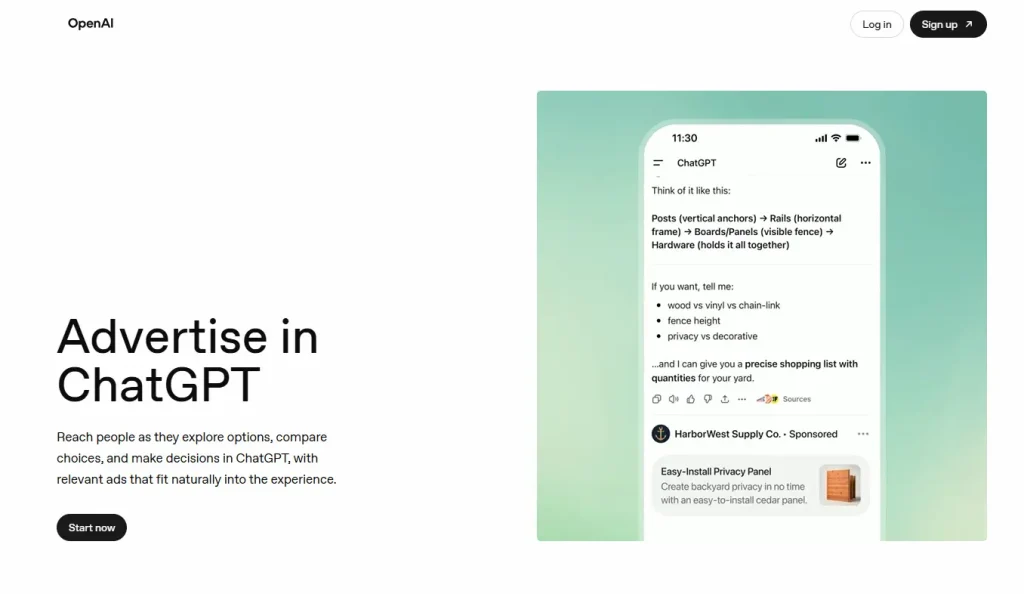
When a user on the Free or Go plan asks ChatGPT a question, a sponsored placement can appear directly below the AI’s organic response. It’s clearly labelled as “Sponsored” and sits visually separate from the answer. OpenAI has been explicit about the fact that ads don’t influence what ChatGPT says. The organic answer remains the organic answer.
The ad format itself is minimal by design, consisting of an advertiser name and favicon, a short headline, a brief description, a landing page URL and an optional image.
Targeting works differently from anything you’ll have used before. There are no keywords to bid on. Instead, advertisers provide “context hints”: phrases describing the types of conversations where their product or service is relevant. If someone has spent the week asking ChatGPT about home improvements and then asks which tools are worth buying, a relevant brand can appear at exactly that moment. It’s intent-based targeting at the conversation level, not keyword matching.
The average cost per click rate in the US is around $3.42 (£2.59), which gives you some idea of how much budget you would need to run a successful campaign. But as with other PPC ad formats, if people aren’t clicking through, then your money doesn’t get spent. So, as long as your targeting is right, your budget will be well spent on some high-intent traffic.
How are ChatGPT ads different from Google and Meta?
The core difference isn’t about targeting options or creative formats. It’s about when someone encounters your ad in the decision-making process.
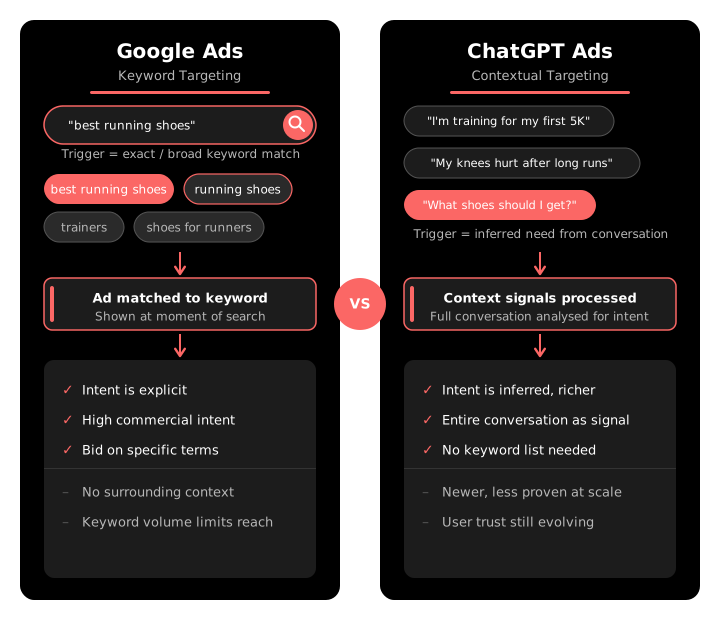
When someone uses ChatGPT to compare products, research a service or work out what to buy, they’re not passively scrolling past an ad. They’re actively in the middle of making a decision, compressing their research and working towards the next step. That’s a commercially valuable moment that hasn’t previously been available as an advertising placement.
The US numbers reflect this. According to eMarketer, ChatGPT advertising crossed $100 million (approx. £75.5 million) in annualised revenue within six weeks of launching in the US. That’s not the behaviour of a channel people see as optional.
This isn’t an argument to move your budget away from Google or Meta. Those channels still reach enormous audiences and deliver strong returns. ChatGPT ads are an additional layer that sits alongside your existing paid strategy rather than replacing it.
What businesses should be doing right now
Audit how your business appears inside ChatGPT. Open it and ask about your business, your services and the problems you solve. Are you being mentioned? Are your competitors? Early findings from US testing suggest businesses already cited organically in ChatGPT responses see their paid placements perform better, because the ad reinforces something the user has already encountered rather than appearing as an interruption.
Review your website content and ensure it is SEO optimised. AI still uses search engine indexes to generate responses, which means you don’t need to abandon traditional practices and start chasing GEO myths and shortcuts. ChatGPT draws on publicly available information about your business. Clear service descriptions, well-structured FAQs and content that directly answers the questions your customers are asking all improve how AI systems understand and represent your brand .
Think about where ChatGPT ads fit in your paid mix. This channel suits businesses where the purchase decision involves research and comparison. If your customers tend to think before they buy, this placement reaches them at precisely that moment. But with the ChatGPT Ads Manager Beta now available in the UK, we’re here to help guide you through how you can get started.
Our thoughts
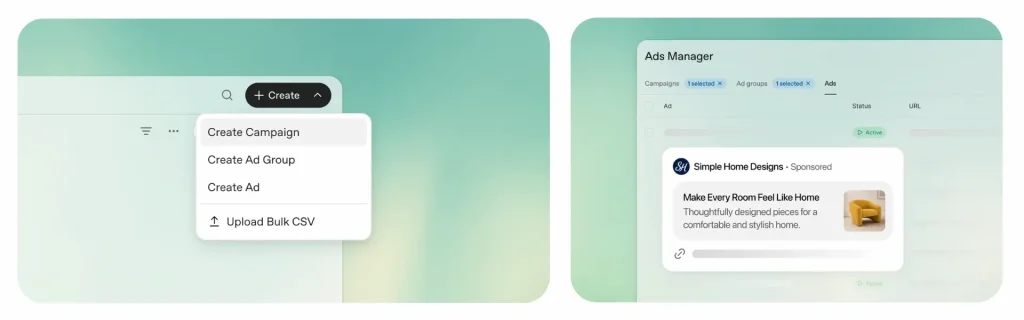
Although it’s clearly still in its Beta stage and comes with some limitations with regards to reporting, targeting and conversion tracking, the general user experience is really positive. Creating a campaign can be done relatively quickly, although approval is currently taking a little longer than you would expect.

At Harrison Carloss, we’ve been tracking the ChatGPT ads rollout in the US closely and preparing for the UK launch ahead of it going live. We’re already addressing client queries around what this means across paid media, SEO and wider digital strategy.
We’re already testing ChatGPT Ads for ourselves to understand how they work, how they compare to other digital advertisements and how they can be used correctly for clients.
If your customers are likely to use ChatGPT to research before making a buying decision, this is a great space to be in.
Proceed with caution (but test with optimism)
While there is definitely a lot of potential based on how the US ads are performing, we advise some degree of caution in moving too much budget away from existing channels and into ChatGPT ads at this stage.
Advertising with OpenAI needs to be seen as an additional touch point in the customer journey that can help you get your brand into consideration during the research phase, not as a complete replacement for search ads.
Update: How things are looking after 6 months of ChatGPT ads
Six months on, ChatGPT ads still don’t have reliable benchmarks for UK advertisers to work from. Reports so far (largely from the US market) show CPCs ranging from under $3 to $10-$13 (roughly £2.30 to £7.60-£9.90) with mixed conversion results, so there’s no consistent baseline yet for judging whether a campaign’s working. For UK businesses running early tests, that means treating results as directional rather than definitive for now.
A few other developments are worth flagging for UK advertisers specifically. As of 4 September, OpenAI now requires a product feed for any brand to appear in ChatGPT shopping placements, a real shift from the organic-only approach we described at launch, and one UK retailers will need to act on if they want visibility in shopping results.
OpenAI has also expanded ChatGPT ads to more than 30 new countries, including parts of Europe, India and the Middle East and North Africa, building on the UK’s early access earlier this year, and shipped a conversational Ads Manager plugin, more flexible audience tools and a Pixel that now accepts hashed contact data for better conversion tracking.
For UK businesses already running or considering ChatGPT ads, it’s a channel that’s maturing fast: wider reach, sharper targeting and tracking, but still one to test carefully rather than commit large budgets to blind.
These ads aren’t going to be right for every business. Knowing if you fit into that category isn’t always clear when you’re on the inside. We can help you understand what your current AI visibility looks like, if your business would benefit from ChatGPT ads, and how to position your ad strategy. Get in touch with our team if you’d like to find out more.